


Studio Confidential Preview: Sylvia Massy on Sessions, Sound, and Recording Secrets
- ezt

- Feb 10
- 20 min read
Updated: Feb 11
This episode’s guest is one of those rare studio minds who makes the control room feel less like a workplace and more like a laboratory with excellent taste.
Sylvia Massy is a producer, mixer, and engineer whose credits stretch from punk grit to arena-scale rock and beyond. Her name is often spoken as she produced Tool’s Undertow, but her story doesn’t start with platinum plaques. It starts in the mid-’80s trenches, making compilations, working with punk bands, engineering metal records, and learning the kind of hard-won lessons you only get when the tape is rolling and the stakes are real. From there, she becomes a crucial behind-the-boards force in Los Angeles, intersects with the Sound City recording studio mythology, and winds up in the orbit of Rick Rubin’s American Recordings era, touching projects that helped define what “big” sounded like in the ’90s.
But the reason I wanted Sylvia on the show isn’t just the résumé. It’s the method. Sylvia is obsessed, in the best way, with recording technology and the physical stuff of sound. Consoles, mics, outboard gear, oddball techniques, and the kind of creative decisions that make an outside sit up and pay attention.Her approach is curious, practical, fearless, and frequently hilarious.
We also talk about Studio Confidential, a new live, in-person onstage conversation series launching in New York City. It’s designed to pull back the curtain on legendary sessions and the people who actually built those records from the inside out. The official residency runs February 14 through March 1, 2026 at NYC’s Sheen Center for Thought & Culture, with multiple shows each week.
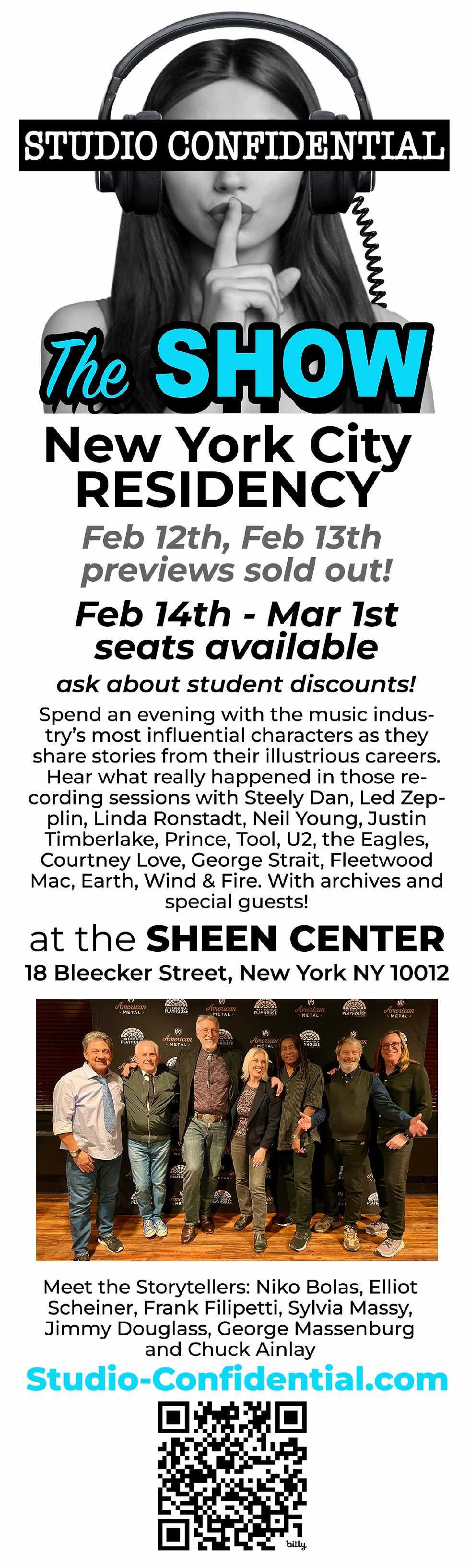
If Studio Confidential is about pulling back the curtain, Sylvia’s the person you want holding the flashlight.
ezt: Sylvia, thank you so much for joining me today. I really do appreciate you taking some time out of your busy schedule to talk to me here on The Sharp Notes. Thanks for doing this. Thank you.
sm: Absolutely. Nice to meet you, Evan.
ezt: You too. A place I think is interesting to start is your career. You've really worked across all genres of music. There's punk there, there's metal, there's hip-hop, pop. You're never a genre producer. Maybe a place to start the conversation is when you walk into a new project, what are you listening to first, the song, the people? I know you put a lot of thought into the room. When you first make that connection, what are you looking for out of people?
sm: Well, I would ask anyone that we're considering working together that they send me a lot of material, songs that they have. If we're going to do an album, I want to hear 50 to 100 songs-
ezt: Wow.
sm: -so I can pick the best or the ones that I think would make a good compilation, the songs that would work together. That's where I usually start is with the songs, because a lot of the rest can be cajoled and manipulated in the studio. It starts with the song.
ezt: Maybe you could explain for folks who are not familiar with it, but one of the interesting things in your production style is recording in unique spaces. Here I am recording this inside of a record store. I don't know what sonic--
sm: I'm looking at the height there. I think that you could do some drums in that room. Probably with the albums on the walls, you've got enough diffusion that it's not going to be too bouncy. I'm looking at that room and thinking, yes, we can record in there.
ezt: All right. We can make something work here. It's funny because in my basement, where I have big shelves of records, where I have much more records. It is a very dry sound. It's very pleasant down there because there really isn't any echo. When you throw people these ideas, "Hey, let's record in a silo somewhere," how do you figure out what's right for that person to suggest?
sm: It depends on how adventurous they are. Some people are very adventurous. I'll drag them around to tunnels, and caves, and churches. Some people, they're not so interested in all that, and I might have to force them a little bit. I hear a dinging. Is that you or is that me?
ezt: I think it was over here. Yes, it was over here in my poorly sound-insulated record store.
sw: [laughs] That's okay. We're talking live.
ezt: We're talking live.
sm: Live from the record store.
ezt: Some people might just want to be a little more straightforward and say, "Hey, look, I don't want to record in a bowling alley. I just want to be in the recording studio."
sm: Bowling alley, great idea. Well, I worked recently with a doom band called Monolord. They're from Sweden. I thought, "Oh, good." There's a train tunnel not too far from me and it's basically abandoned. It's a great place to record. I thought, "Oh, we're going to take them up there." Then they showed up and they were not interested in any experimentation, really. Maybe a little, but no, they didn't want to even go outside for the most part. I'm not going to push anyone into anything that they don't want to do.
We made a great record. Ultimately, I did have them, the guitar player, Thomas V. Jaeger, he was resistant to trying some experiments with light bulbs. I like to run power drills. I like to run audio through power drills and have the drills run and hear the sound of the motors in the audio. They were patient enough to let me set it up. Ultimately, these recordings did make it on the record. We played bass through a power drill, and it's on the record. Wow. It's great, and it's perfect, actually.
These things, these experiments, and taking people out of their comfort zone is particularly to get them to start thinking on their own, thinking outside the box, thinking outside the studio, and to get their own ideas going. I might throw out an idea like, "Hey, let's go do this." They're like, "No, but why don't we try this?" I'll follow their lead, and I'll just throw meat at them and see what they pick up.
ezt: What they chew on, yes.
sm: Yes, what they chew on.
ezt: Of course, this element of playfulness is a part of your resume now. People may be
ready to expect that from you if they're working with you. Take us back. A lot of us have jobs, different jobs, not in the audio industry, careers. There's that element of playfulness, of creativity, of fun, of experimentation. What was it like doing that at first, maybe when people weren't into that? Do you remember the first moment that was like, hey, let's really do this thing?
sm: That was right from the beginning. It never occurred to me that people didn't do that. Why do you have to be in a studio? Why do you have to use this certain mic? There's no rules, really. I never went to school for this. I wasn't actually taught anything. [chuckles] I just was making it up as it was going on.

Why can't you put audio through a pickle? Why can't you? If we laugh and laugh and laugh and get nothing out of that whole recording session, we've still done something that we'll never forget. The way I plan my sessions is that we can have a couple days at the end of a good week of recording, perhaps. Only at the end will I pull out these tricks because I want to make sure that all the important things are finished and recorded, and we won't run out of time if we lose a day. That's how I build it into the session so there's less stress that way, and they're not looking at the clock all the time.
ezt: Right, not worried like, "Hey, are we getting this thing really done?" or, "What are we doing in this cornfield?"
sm: [chuckles]Exactly.
ezt: Right. One of your first big breakthrough projects, of course, was Tool's Undertow album. It's just interesting to think, from its original release to now, it was reissued on vinyl just last year. I said part of our conversation would be a little vinyl-based. A lot of classic jazz albums are always being reissued. A lot of the classic stuff that you'd expect to be reissued has been reissued.
Lately, it seems like there's a push for some of this '90s heavier stuff, metal and hip-hop, to get that audiophile treatment, that really nice reissued treatment. I did recognize that that album had been reissued last year. Do you have a take on that? Of course, you've been involved in that world for so long, and now it seems like it's coming around the bend, where people want to hear this stuff even in better quality.
sm: When I first moved to Los Angeles, I worked at Tower Records because I couldn't get a studio job.
ezt: Fascinating.
sm: I'd moved from San Francisco to LA, and I thought I could walk into a job, but I couldn't, so I wound up working at Tower Records. That was an era where it was vinyl and CDs were just starting to come in. That was the late '80s. The '90s missed out on the vinyl entirely. All that music, basically, was recorded and released on CD. A lot of it was recorded on tape, but ultimately was brought out on CD. Now I'm just thinking that these people are finally getting a chance to really present an album the way that we all love albums to be.
I don't know. I have some albums here, and they just come to me now. This is some of the records that the Monolord band released. This is one of their records. It's color vinyl. It's a double album. It's got all liner notes. It's got photos. You can read about the people and read stories about what they did. It's just so fascinating. The cover art. I miss that so much. You don't get that with CDs. We're all enjoying this new world with the new old world. [chuckles]
ezt: Yes, the new old world, that's for sure. Especially since we're in a record store here, and Tower Records, Los Angeles, was such an iconic record store, tell us about those days simply working at the record store and interacting with all that fabulous product, and the interesting people that I'm sure would come in. Maybe you've got a few Tower Records stories to share.
sm: Oh, boy. It was a celebrity hotspot because everyone would come in and buy music, and it was like I'd see, oh, sports stars and film producers. Elton John came by. They'd have events in the parking lot, too. One was for the release of David Lee Roth's Skyscraper album. They actually built a fake mountain on top of Tower and had David swinging on a rope coming down the mountain to promote the record. It was with stages, and people everywhere, and the streets blocked.
Wow, there was some really exciting days. A lot of people were working at the record store doing the same thing I was, just trying to get my foot in somewhere outside of the record store. For instance, the guys over at Tower Video across the street, that was Axl Rose and Slash were working over there, and then they bounced up when they got their deal and left.
Then I met all my friends there from the band Green Jellö. Most of us were working at Tower. Then that became my first LA production, basically working in an eight-track with Green Jellö. Then they got a deal out of that, and we went into the studio for the Green Jellö record. This was a real studio, Sound City. Because Danny was playing with Green Jellö at the time, Danny Carey, we had his drum set up for that, and Tool also needed to do an EP. Since the drums were set up, we just cut the Tool EP right there. We did like four or five songs at Sound City with Tool also.
A lot of stuff happened at Tower. It seems like when I first moved to LA, I had already been producing for about six years in San Francisco, and I had some success working with Kirk Hammett and the Sea Hags, but going to LA, I could not get a job in a studio. Working at Tower was my way in. It seemed like one step down, but then two steps ahead. It really worked out.

ezt: Very cool. I remember those Green Jellÿ records coming out, or Green Jellö at the time. We were all, "They had to change their name." We were really interested in that. This-
sm: Woo...
ezt: -was very controversial at the time. You talked about Sound City a little bit, and maybe this segues into some new products you're going to be putting out, but we're talking about vinyl, we're talking about physical product, we're talking about things in microphones, and things that do things. Tell us a little bit about your love affair with equipment. Obviously, you've made a career out of it, but you have a real museum. Your website is great. You've got a lot of interesting information on the website. Just tell us a little bit about how that's different from the recording process, these items that you bring, different elements to sound, and how you learned about them, and how you catalog them yourself.
sm: That's an interesting story because when I started out, and I would go to recording studios, professional recording studios, they'd have basically the same kind of equipment. All of them. There would be a good recording console and some rack gear. I found that certain items that I needed were not typical for recording studios. For mixing, I used to love to use the AN-2, which was a spatial simulator by a company called Studio Technologies. It was a one-rack space thing. No one had that, so I had to buy one. Then I put it in a rack, and I started carrying that one item with me.
Then that turned into two things when I had to get a DBX-120DX for subharmonic synthesizing. That was something else that no one had in their studio, so I would carry it in. That whole acquisition thing got out of control because I discovered, through a friend, Jimmy Boyle, some classic tube compressors that were originally released for broadcast use. They were found in radio stations, but not in recording studios. There was a whole bunch, like all these gates, and Collins, and RCA, and all this broadcast gear, and no studios had this. I started collecting them one at a time. Then I really started collecting them.

I go out to Chicago and go to a broker for used equipment. I'd wander in his warehouse, and I'd say, "I want that, and I want that, and that." Then he was shipping them to California. Then I started selling these things to my friends. We all started getting into this broadcast thing. That was early '90s. It finally caught on later, and you'll see a lot of those in studios now and reproductions of the old broadcast stuff.
At the time, it was like, "Ooh, we're onto something. This is new." They sound different. For vocals, the broadcast compression oftentimes is really muscular, and it'll bring the voice right up front. That's what I wanted for music for these records.
Even today, now, I have all the gear that-- I don't need any more gear, seriously. When there's a new prod project, if they are using a certain amp, a guitar amp, that I don't have in the collection, and they're coming from Europe, I say, "You keep your stuff home. I'll get one of those." I recently bought an Orange OR-80 Amplifier, a guitar amp, which is a monster. I still am buying gear today. However, that's slowed down quite a bit [laughs].
ezt: It's interesting that you bring up the radio stuff because-- I don't know if you watched Stranger Things, but in the last season here, they were in a radio station, and it was an old, like a late '70s, early '80s style thing. They had all these tube compressors behind them, or transmitters, or whatever they had inside the studio at the time. I was thinking, "Wow, people are going to be like what is that?" because now the radio stations are totally digital. They don't have anything even remotely like that now.
sm: Most studios are on a laptop. You don't need any of this, really. I mean, boy-
ezt: Or do you?
sm: -but it did not-- Or do you? Yes. I use as much as I can. It's also really nice to just have everything right there in the box. It's a interesting time because everyone's being able to choose things from the past and bring it into the digital world.
ezt: Yes, combine them a little bit. How about this book? You've got a book about microphones in particular coming out. Can you tell us about that?
sm: My husband, Chris, and I started on this journey about 10 years ago when our publisher for Recording Unhinged asked us to write a book about microphones. We thought, "Ah, that'll be easy. I've got microphones. I got 500 microphones in my studio. No problem." We started researching it and found out that there's a lot more to mics than just studio mics.
There's so many mics out there. I started going to museums.
There was a museum in Milwaukee that a fellow named Bob Paquette put together over his lifetime. There was about 3,000 mics there, and there was RCAs, Western Electrics, all the- right back to the beginning. I went there to research for the book and made friends with them, the family, and all.

When he passed, Bob passed, because he was very old, the family called us up and said, "Hey, could you help us with this collection? We want to keep it together for Bob's memory, but everyone that we're talking to wants to only buy this one and this one," because he had some beautiful Telefunken mics and some vintage Germans that everybody wants those. They didn't want to sell those and then leave the whole rest of the collection without--
Somehow, my husband found a way to buy this collection. He negotiated with the family, negotiated the price and the terms so that we could pay it off over time. We bought it. In 2019, he brought home two truckloads, like a shipping container and a truckload of equipment. It was like the best day ever. The best day ever.
ezt: Yes, how exciting.
sm: It took weeks to unpack and figure out what was in this collection. Part of it we sold because it was all radio equipment, and military non-microphones. We kept the microphones and sold off the rest of the gear, and were able to pay off this big loan. Now we're displaying a lot of the mics in the studio. It's not open to the public yet, but I imagine one day it will be, and it's still growing.
My friend, I'm talking about this Monolord record, again, the doom record, which I had so much fun doing. The singer from that band, I wasn't sure if he was really happy with the record because this is someone that never really smiles.
Again, I'm asking, "Does Thomas like what we're doing?" because he doesn't show you. They said, "Yes, we've been living with him for a long time. We have the same problem." Ultimately, he sent me a package after the album was done, and the package had candy and gifts, and these two microphones I have sitting here, two microphones, these Swedish microphones.
ezt: Wow.
sm: They're pearls. How wonderful that he would send-- I think he liked the record, ultimately. He sent me some vinyl of his, too. That's him smiling.
ezt: He's like, "I was the happiest I've ever been with you."
sm: "I love the record." [laughs] Anyway, I have a bunch of mics out here because every day I pull out a mic and just have it with me just to enjoy it. This is a Cording radio. This is German '40s, or it could be '30s. What else do I have? Oh, this one is super. This is really interesting. This is an AKG D25. It's one of the D series, which is great for kick drum, great for vocals. This one is a wreck because someone sent it to me after they found it in a dump. They found it under trash, and they pulled it out and they said, "Sylvia is going to want this." They were so right. We are a home for all microphones, unloved or loved.
ezt: Funnily enough, a mic like that in a dump could be repaired by the right person to have a new life. That's not something you can say about a lot of things that are being created today, new microphones. Well, we won't be talking about them in 100 years, but will people be talking about a microphone built and sold in the year 2026, 100 years from now? Probably not.
sm: Maybe not. This mic, I plugged it in and it works. It's a dynamic, right?
ezt: Yes.
sm: 100 years from now, I don't know. There are some good mics being made now, actually. The funny thing is I've got a mic. Can I show you one more mic?
ezt: I would love it. I'm enjoying the show and tell.
sm: I got to go over in the case over here. Hang on.
ezt: Go ahead. I love it.
sm: Well, here's a good mic. This one, talk about 100 years old. This is from 1878.
ezt: Unbelievable.
sm: [laughs] This is a mic by David Edward Hughes. You'll see on the inside it has a stick. It's like a pencil. They call it a carbon pencil. That is actually a piece of burnt carbon. It's like a burnt stick dipped in mercury.
ezt: Wow.
sm: It's suspended between these two posts. Now you hook a wire on this post, you hook a wire on this post, put that to a battery. In the loop, you put a little speaker, which would be like a telephone receiver or something. That is a microphone right there. A stick, a burnt stick. You believe that?
ezt: A burnt stick.
sm: This is 1878, so a hundred and-- how many? 130 years old?
ezt: 1878 is a hundred and-
sm: 150 years.
ezt: I was born in '78, so 147-ish years, 148 years.
sm: Almost 150 years old, and we are talking about it. That's why we wrote this microphone book, and it's nearly finished. The publisher is really excited about it, and we are, too. It's a book about the first 100 years of microphones. It starts chronologically with these very early mics and all the way to the really popular telefunkens, and AKGs, and all the really desirable mics.
ezt: Fascinating. Of course, we're talking about your studio gear, things that you use for studio. How do you switch off to just listening for pleasure? You do a lot of recording? You're in the studio all day. You've got all your studio gear. Do you have a home rig, a stereo that you sit and listen to, or are you just really listening through your recording studio stuff?
sm: Well, that's funny because listening for pleasure doesn't happen nearly as much as I wish. Well, I can't say that because most of the music that I work on is really so good that I would listen to it anyway, just for fun. I generally listen in the car when I'm driving around. If it's music that I didn't work on, it's usually vintage jazz. Lately, I'm into Bossa Nova. I will keep up on the modern music, too. I want to keep fresh on what's happening. I try to keep up.
ezt: You've done a lot of work with Rick Rubin, whose approach people know about, emphasizes reduction and instinct. Did that partnership sharpen your own philosophy about when to interfere in a recording and when to get out of the way? What were some of the things that you learned through the projects that you worked on with him?
sm: Well, I spoke about how the song is the most important thing for me and how I'll ask a new artist to write 100 songs. If we're going to do an album with 12 songs, give me at least 50. Well, Rick was the one who showed me how to do that. That was from the work he did with the Red Hot Chili Peppers, I think on Blood Sugar Sex Magik. I think they were tasked to write 300 songs for that album by Rick.
The thing about Rick is because he's concentrating on those songs, he's a fan. He's listening for what song will connect with an audience. That's his, I think, one of his magic traits, is that he can really tune into what people are going to connect with. Beyond that, he'll get the right personnel on a session, but it's pretty much like he picks the songs, and then he puts all the people together in the right studio, and then he just lets it happen. Pretty much, he'll be there for tracking, and he'll hand over the reins for a lot of the overdubs.
I absolutely think he's brilliant because when he walked in the room whenever I was working with him, he would walk in the room, oftentimes after not being there for a couple of days, and he would have just the right things to say after we would play him what we've been working on. Bam, bam, bam, bam, then he was out of there.

I learned that same thing from Prince, too, because I worked with Prince for three years. He would have several studios running at the same time. Usually, he'd book out the entire facility at Larrabee, which was two rooms. Then he'd also have rooms over at the record plant. Then he'd have an engineer or a mixer in each of these rooms. I got to be one of his engineers. I did some mixing, and I assisted a bunch of stuff, too.
I spent a lot of time with him. He would go from room to room. He would come in to one room, I'd have everything set up for him, a drum machine and a keyboard with a bass patch, and all the guitars lined up, pedal boards and whatever. Whatever he would reach for, I would have the machine and record. He would take his left hand and play on the drum machine, kick, snare, hat. He'd be playing a beat like that. He'd be playing the baseline to that. He'd just play that, and I'm recording it. Then he would say, "Okay, that's the verse." Then he'd play another thing. "Okay, that's the chorus."
There was no quantizing this drum machine. It was live. He would do that. Then he would leave the room, and I would assemble that song. Then he'd come back, and then he'd put on some parts. When he would leave the room, he was going to the room next door, or he would leave the facility and go over to the record plant and be working in those rooms. Oftentimes, we didn't know when he was going to show up, but we were all working crazy.
ezt: Wow.
sm: I learned so much from that multi-room approach to production that I was able to do that same thing in Weed when I set up five different rooms with five different engineers and just me producing. I would just pop between rooms and see, with different projects in each room to follow through on the production. It worked brilliantly for about 20 years.
ezt: Unbelievable. I guess if you really want to create a body of work, a catalog that's really meaningful, you do need that large amount of music and work to choose from. You can't just write 10 songs and be like, "Hey, these are the 10." I guess some people work like that, but you need to have some stuff to choose from, I guess, if you really want to be successful.
sm: Well, I think that it's a good exercise for-- Don't be so precious on one song that you're going to work on it for a year. Just let the oil flow. Pump the oil out of the well. It keeps coming. It keeps coming, you know?
ezt: Yes, Now you're making me think of recording in an oil well. Now we're going to record in an oil well. Okay, I'm just kidding with you.
sm: I haven't done that yet.
ezt: [chuckles] You were mentioning you had an event coming up in New York City. We're here in New Jersey, just across the river. What's coming up? What do you have?
sm: Well, in February, we will have a residency at the Sheen Center in the village, and we have a show. We, when I talk about we, well, it's a group of producers, some veterans like George Massenburg, Chuck Ainlay, Elliot Scheiner, Niko Bolas, Jimmy Douglass. All these guys, we sit around and tell stories. Frank Filipetti has a story about traveling to Africa to record, and it's so heartwarming. Then there's funny stories too. Elliot worked with Steely Dan for years, and they wrote a couple of big hits about him. He talks about that.

Jimmy Douglass did the edits on the most famous guitar solo that I can think of, which is the Led Zeppelin "Heartbreaker", [hums] that thing. He put the edits in there, and he talks about how he did that. We have these wonderful stories. I talk about Prince and all the naughty things he was doing.
ezt: Oh, my.
sm: That's why it's Studio Confidential. It's called Studio Confidential, and it's a great date night for anyone who wants to get out and hear some great stories from some pros. Be looking for that. It's at the Sheen Center throughout the whole month of February.
ezt: Very good. Sylvia, how can people find out more about you and what web places they should go to learn more about you, and your microphones, and your books, and your speaking engagements, and all that stuff?
sm: Well, I have a website that it has everything in it. I built it myself, so it's kind of funky, but it's fun. It's sylviamassy.com. It's pretty easy to find. My name is spelled M-A-S-S-Y, no E, so you'll be able to find it there. [chuckles]
ezt: The big question is, what microphone did you use to record this interview today?
sm: Oh, so disappointing. It's the thing on the laptop here.
ezt: Why didn't you use the wooden thing with the mercury that Thomas Edison made?
sm: [laughs] Ah, it might have sounded better. [chuckles]
ezt: It might have. It might have.
sm: Yes.
ezt: Sylvia, it's a pleasure talking to you today. I really appreciate your time. This was a really fun conversation, and it would be fun to see you and the other folks do your thing in New York City. Hopefully, I can get out and see you guys do that.
sm: Well, thanks, Evan, and great to meet you here. I hope to see you again soon.


Comments